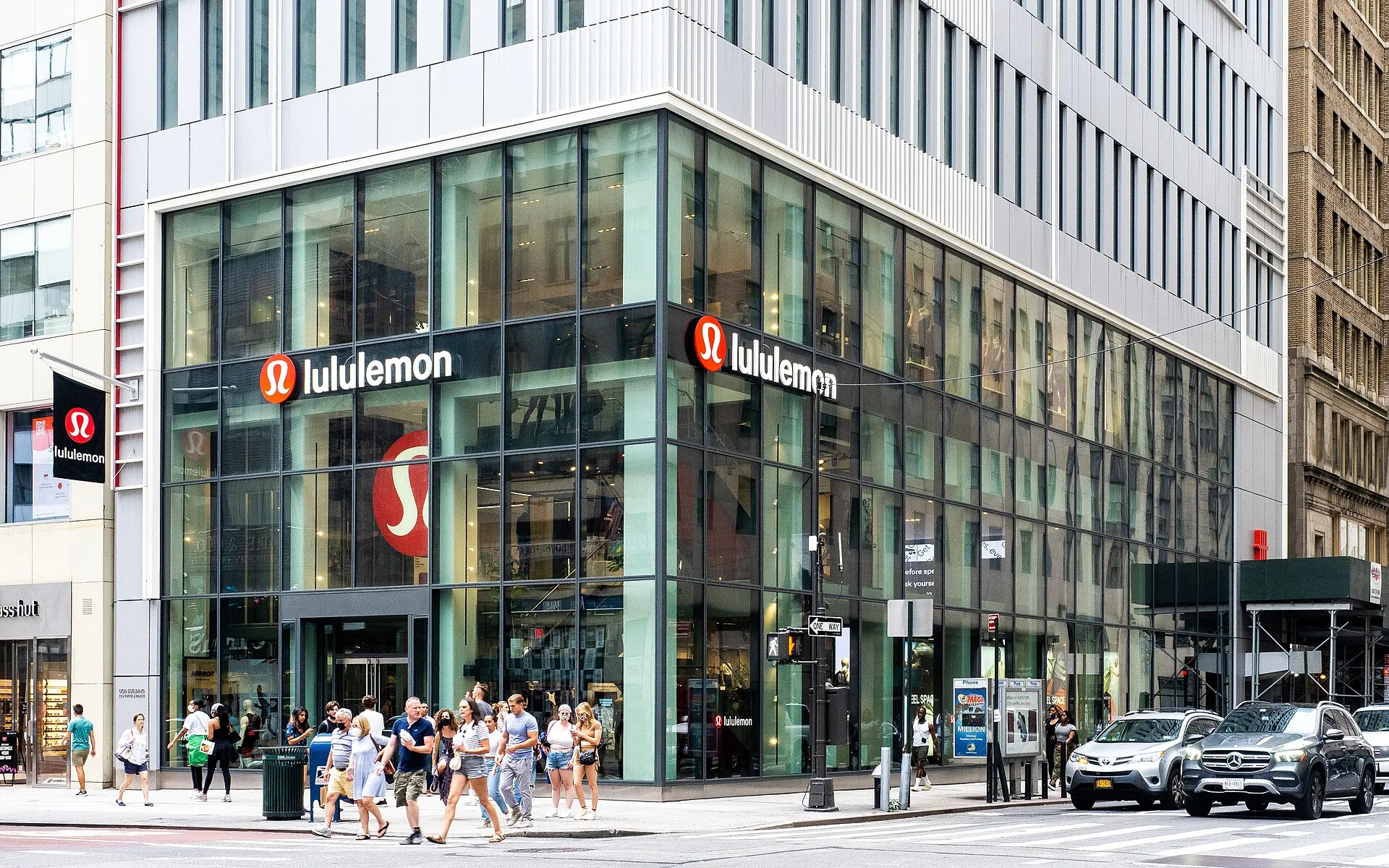
Lululemon beat its own earnings guidance by more than 60% and the stock fell 17.4% in a single session. That is not a typo, and it is the cleanest illustration this year of how little a headline EPS number means on its own. lululemon athletica inc. (NASDAQ: LULU) closed at $100.61 on Friday 4 September 2026, down from $121.77, after touching $97.99 intraday – the first time the shares had printed below $100 since May 2018. The stock is down 51.6% in 2026 and 80.3% from its December 2023 closing peak of $511.29. A brand that people still queue for has become, in the phrase circulating on Reddit this weekend, a perfect example of how “a great brand can be a terrible stock.”
Here is the part almost none of the coverage led with. Diluted EPS came in at $2.92 against company guidance of $1.76 to $1.81 – but $0.86 of that was a one-off refund of tariffs. lululemon received $134.5 million of International Emergency Economic Powers Act refunds in the quarter, plus $4.1 million of interest, after US courts struck the IEEPA tariffs down. Strip it out and EPS was roughly $2.06 against $3.10 a year earlier, a 33% decline. The same refund flattered gross margin by 560 basis points and operating margin by 560 basis points. Reported gross margin rose 200bp to 60.5%; underlying, it fell around 360bp. Reported operating margin fell 190bp to 18.8%; underlying, it fell about 750bp. The “beat” was a cheque from the US government, and the company’s outlook explicitly assumes it does not repeat.
Key facts
- -17.4% in one day – LULU closed at $100.61 on 4 September 2026, down from $121.77, on 37.1 million shares
- $97.99 – intraday low, the first sub-$100 print since May 2018 (last close below $100: $98.95 on 15 May 2018)
- $134.5m – IEEPA tariff refunds recognised in Q2, worth $0.86 per share, or 29% of reported EPS (lululemon 8-K, 3 Sep 2026)
- -9% comparable sales, with Americas comps -12% and international comps -3%
- $12.20 to $8.74 – FY2026 EPS guidance midpoint from March to September, adjusting the latest figure for the one-off refund: a 28% cut in under six months
- $688.3m – spent on share buybacks in the first half of fiscal 2026, while the stock halved
- 8 September – the day incoming CEO Heidi O’Neill starts, four business days after the crash
What actually happened in the quarter
For the second quarter of fiscal 2026, which ended 2 August, net revenue fell 4% to $2.4 billion, or 5% on a constant dollar basis. The split is where it gets uncomfortable. Americas net revenue fell 8%; international net revenue rose 4%. Comparable sales – the measure that strips out new store openings and is therefore the honest read on whether existing shops are busier – fell 9% overall, and 12% in the Americas. International comps fell 3%.
Income from operations fell 13% to $453.7 million. Net income fell to $329.2 million from $370.9 million. Across the first half, net income is down 23.5%, from $685.5 million to $524.3 million. The company ended the quarter with $1.4 billion of cash, inventories down 1% in dollars and 7% in units, and 825 stores after opening nine net new ones.
None of that, on its own, explains a 17% single-day fall. Retail stocks routinely absorb a soft quarter. What they do not absorb is the guidance.
The number that did the damage
Track lululemon’s own fiscal 2026 outlook across three filings and the story writes itself.
| Outlook set on | FY2026 revenue | FY2026 diluted EPS |
|---|---|---|
| 17 March 2026 | $11.350bn – $11.500bn (+2% to +4%) | $12.10 – $12.30 |
| 4 June 2026 | $11.000bn – $11.150bn (-1% to 0%) | $10.95 – $11.15 |
| 3 September 2026 | $10.350bn – $10.500bn (-5% to -7%) | $9.48 – $9.73 |
In under six months the revenue outlook has been cut by roughly $1.0 billion at the midpoint and moved from growth of 2-4% to a decline of 5-7%. The EPS midpoint has gone from $12.20 to $9.61 – and the September figure includes the $0.86 of one-off tariff money. Remove it and the underlying guidance is about $8.74, which is 28% below where the year started.
The third-quarter guide is starker still: revenue of $2.290bn to $2.320bn, a decline of 10% to 11%, with EPS of $0.93 to $0.98. That is the first double-digit revenue decline lululemon has guided to, and it is the number the market actually traded on. A soft quarter is a data point. A guide that says the next quarter will be materially worse than the one that just disappointed is a trend.
The Americas problem is ten quarters old, and accelerating
This is the part that turns a bad quarter into a structural argument, and the person who has been making it loudest is the man who founded the company.
In a statement filed with the SEC on 18 March 2026, founder Chip Wilson wrote that “Fourth quarter 2025 Americas comparable sales represent the eighth consecutive quarter of decreased or flat results, and the outlook for fiscal year 2026 indicates no meaningful change in trajectory.” Two quarters have been reported since. Q1 2026 Americas comparable sales fell 5%. Q2 2026 Americas comparable sales fell 12%. By the founder’s own count, that streak now stands at ten consecutive quarters – and the sequence over the last three is -1%, -5%, -12%. The decline is not flattening. It is steepening.
International is genuinely working: comps there fell only 3% and revenue grew 4% despite a tougher year. But international cannot yet carry the company. The Americas remains the majority of the business, and it is shrinking at an accelerating rate while the company opens stores into it.
A leadership vacuum, filled four days too late
The crash landed in the middle of an unusually thin management structure. lululemon has been run since earlier this year by two interim co-CEOs: Meghan Frank, who is also the chief financial officer, and André Maestrini, who is also president and chief commercial officer. It was Frank who delivered the results, saying the company is “taking a prudent approach with our revised full-year outlook” and that teams remain focused on “strengthening our product offerings, increasing our marketing investments, and maintaining disciplined expense management.”
Maestrini’s line in the same release now reads like unfortunate timing: “We look forward to welcoming our incoming CEO, Heidi O’Neill, next week as we begin an exciting new chapter for the company.” O’Neill, a near-30-year Nike veteran, was named in April and starts on 8 September – four business days after the stock hit an eight-year low. She inherits a guidance cut she did not write.
The C-suite has been thinning elsewhere too. On 13 August 2026 the company disclosed in an 8-K that Ranju Das had “ceased to serve as Chief AI & Technology Officer,” with transition plans in place for his responsibilities.
And Wilson is not a passive observer. He and affiliated entities beneficially own 9,570,851 shares, or 8.6% of the company, and he is running an active proxy campaign – a GOLD universal proxy card, a dedicated campaign website, and three nominees – to force board change. His March statement called the company “in dire need of significant and substantial refreshment of the board of directors” and said he was “prepared to continue the effort for as long as necessary to effectuate the quantum of change required to return lululemon to its premium position.” Notably, his group’s stake has drifted down from 9,904,856 shares in March to 9,570,851 in the 3 September filing, even as the percentage ticked up – because the company’s own buybacks have been shrinking the share count faster than he has been selling.
Why a great brand became a terrible stock
The framing doing the rounds since Friday – one r/NemoMoney post put it as “wild one for anyone who’s ever paid $120 for leggings” – is the right one, and it is worth taking seriously rather than treating as a meme. Brand affection and equity returns are different things, and lululemon has become the textbook case of the gap.
The mechanism is straightforward. A premium apparel business is valued on the assumption that it can hold price and keep growing units. When comparable sales fall 12% in your core market for a tenth straight quarter, the market stops paying for growth and starts paying for cash flow – and it re-rates hard, because the multiple was doing most of the work. lululemon’s stock has fallen 80% from its peak while the business is still highly profitable and generating an 18.8% operating margin. Those two facts are not contradictory; they are what a multiple collapse looks like.
The capital allocation makes the arithmetic worse rather than better. lululemon repurchased 2.2 million shares for $358.3 million in Q1 and 2.7 million shares for $330.0 million in Q2 – $688.3 million in six months, at prices between roughly $120 and $180, into a stock that has since traded at $97.99. Buybacks into a falling multiple destroy value in exactly the way they create it into a rising one, and the company has been doing a lot of it.
There is also a macro layer that has nothing to do with leggings. The tariff refund that flattered the quarter exists because US courts struck down the IEEPA tariff regime – a ruling that moved markets well beyond retail, as we covered when the Supreme Court struck down the tariffs and when the ruling drove a gold rally and dollar caution. For lululemon it produced a $134.5 million windfall that arrives once and then never again, at precisely the moment underlying margins were deteriorating. The refund did not cause the sell-off. It disguised how bad the quarter was, right up until anyone read the footnote.
The consumer backdrop is not helping either. US August payrolls came in strong enough to raise Fed hike odds, which is good news for the economy and bad news for discretionary spending at $120 a pair. And competition at the value end has never been fiercer, with Shein pushing toward a Hong Kong listing. Meanwhile the company that supplied lululemon’s next chief executive is fighting its own repositioning battle, as our piece on Nike’s index and strategy shifts sets out.
Frequently asked questions
Why did Lululemon stock drop 17% on 4 September 2026?
Because of the outlook, not the quarter. lululemon cut its fiscal 2026 revenue guidance to $10.350bn-$10.500bn (a decline of 5% to 7%, from a March guide of 2-4% growth) and guided third-quarter revenue down 10% to 11%. The reported EPS “beat” of $2.92 included $0.86 per share of one-off tariff refunds, so underlying earnings actually fell about 33% year on year.
What were the IEEPA tariff refunds in Lululemon’s results?
lululemon received $134.5 million of International Emergency Economic Powers Act tariff refunds plus $4.1 million of associated interest in the second quarter, after US courts struck the tariffs down. The refund was booked as a reduction in cost of goods sold, adding 560 basis points to both gross and operating margin and $0.86 to diluted EPS. The company’s outlook does not assume any further refunds.
How far has Lululemon stock fallen from its high?
LULU closed at $100.61 on 4 September 2026, down 80.3% from its closing peak of $511.29 on 29 December 2023, and down 51.6% so far in 2026. The intraday low of $97.99 was the first sub-$100 print since May 2018; the last close below $100 was $98.95 on 15 May 2018.
Is Lululemon losing customers in the US?
The comparable sales data says yes, and has for some time. Americas comparable sales fell 12% in Q2 2026, 5% in Q1 2026 and 1% in Q4 2025. Founder Chip Wilson stated in a March 2026 SEC filing that Q4 2025 marked the eighth consecutive quarter of decreased or flat Americas comps; the two quarters reported since have both declined, taking the run to ten.
Who is running Lululemon right now?
Until 8 September 2026 the company is led by two interim co-CEOs: Meghan Frank, who is also CFO, and André Maestrini, who is also president and chief commercial officer. Heidi O’Neill, previously a near-30-year Nike executive, was named CEO in April 2026 and takes over on 8 September. The company also disclosed on 13 August that its Chief AI & Technology Officer had left.
What is Chip Wilson’s fight with the Lululemon board about?
Wilson, the founder, and affiliated entities hold 9,570,851 shares – 8.6% of the company – and are running a proxy campaign for board change, with three nominees and a GOLD universal proxy card. In a March 2026 statement filed with the SEC he described lululemon as “in dire need of significant and substantial refreshment of the board of directors” and said he was prepared to continue “for as long as necessary.”
Why does the stock keep falling if the brand is still popular?
Because brand affection and equity returns are different things. lululemon still earns an 18.8% operating margin, but a premium multiple is paid for growth, and Americas comparable sales have now declined for ten consecutive quarters at an accelerating rate. When growth stops, the multiple compresses – which is why an 80% share price decline can sit alongside a business that remains solidly profitable.
This article is analysis and information only. It is not investment advice and contains no price targets or forecasts.