The obvious reading of the slide in IREN Limited is that the AI-cloud contract book broke, and it did not. Nasdaq’s official close on Friday, 23 October 2026, was $24.905 on volume of 39,056,460 shares, down 2.37% from the prior close of $25.51, inside a day’s range of $24.88 to $26.47, and 43.6% below the 25 September close of $44.125. Using the last 90 daily log-returns, the sessions through 31 December 2026 put a bull at $30.63, a base at $15.85, and a bear at $10.22, and the base sits under that close because the 90-day drift is negative. The bull keeps that drift and clears Friday by only $5.72, so these levels are the recent distribution, not a cancelled Microsoft contract and not a higher bull written in to look constructive.
What the consensus still misses is that the contract book and the share count did not move together on this leg. The last ordinary-share count in the annual report is 394,058,648 as of 14 August 2026, and that same count applied to $44.125 and to $24.905 takes equity from about $17.39 billion to about $9.81 billion. The Form 10-K still shows a Microsoft agreement of about $9.7 billion, Horizon 1 accepted in August 2026, Horizons 2 through 4 targeted for calendar Q4 2026, and an NVIDIA cloud contract of about $3.4 billion. The tape repriced the multiple, and the filed book did not shrink with it.
This is not financial advice. It is a path from official closes.
Key facts
- Nasdaq’s official close for IREN was $24.905 on 23 October 2026, down 2.37% from $25.51, on volume of 39,056,460 shares, per Nasdaq’s historical table.
- The 20-day average is $34.39 and the 50-day average is $39.48. Friday’s close is 27.6% below the first and 36.9% below the second, calculated from the saved Nasdaq series through 23 October 2026.
- Across 16 through 22 October, the high was $29.27 and the low was $24.855. Friday’s close is $0.05 above that low and $4.365 below that high, on the same Nasdaq series.
- Ordinary shares outstanding were 394,058,648 as of 14 August 2026, in the Form 10-K filed 27 August 2026. At Friday’s close that count is about $9.81 billion, against about $17.39 billion at $44.125 on 25 September.
- The 10-K puts Microsoft at about $9.7 billion of contract value, says Horizon 1 was accepted in August 2026, targets Horizons 2 through 4 in calendar Q4 2026, and gives grace periods from mid-Q4 2026 to the beginning of Q2 2027. The NVIDIA contract is about $3.4 billion.
- Cash was $5,895.6 million and restricted cash was $1,723.9 million at 30 June 2026. Convertible notes principal was $6,745.7 million. Capital commitments were $13,810.0 million, against $368.8 million a year earlier, all in the 10-K.
- The 27 August results exhibit targets $4 billion of contracted ARR by 31 December 2026 and reports $1 billion of operating ARR as of 26 August 2026. Recognized revenue may be materially lower. Source: the FY26 results exhibit.
- On 14 October 2026, Gartner senior director analyst Will Sommer told The Register that AI providers are expected to spend nearly $1 trillion on AI infrastructure in 2026. IREN closed that day at $30.56, from $34.80, a 12.2% drop.
What just happened, and why the obvious reading is wrong
From the 5 November 2025 close of $76.41, Friday is down 67.4%. The leg that sets this call is the one since 25 September. A chart-only reading says the AI customers flinched. The August filings still describe the book, and nothing opened here shows it cancelled in October.
On 14 October the close was $30.56 after $34.80, the session that lined up with the Gartner warning. FinanceFeeds reported the forecast as a neocloud story, not as a cancelled IREN contract. The close kept falling. Friday printed the lowest close in the year of bars on this chart.
The 10-K says revenue generally begins only after compute is delivered, commissioned, placed in service, and accepted. A signed, prepaid contract can still show little GAAP revenue. A softer quarter will not, by itself, prove the book broke.
The share count explains the earlier de-rating, not this leg. Ordinary shares rose from 258,103,209 on 30 June 2025 to 394,058,648 on 14 August 2026, up 52.7%, including 13,865,040 shares after the 30 June 2026 count of 380,193,608. No later filing opened here updates 14 August. A 43.6% drop after that date is a multiple move if the count held.
The 30 July 2026 session stays in the 90 log-returns. The close went from $29.31 to $38.26, a log-return of about 0.266. One up day does not cancel a negative mean. The formula does not drop it.
Who is exposed
IREN Limited, formerly Iris Energy, is the issuer. The holders of 394,058,648 ordinary shares carry Friday’s price, as do the holders of $6,745.7 million of convertible notes principal at 30 June 2026. A lower share price changes the conversion math. It does not erase that principal.
Microsoft is the hyperscaler on the Horizon buildings at Childress: about $9.7 billion of contract value, Horizon 1 accepted, Horizons 2 through 4 still a schedule. NVIDIA is a customer on a five-year contract of about $3.4 billion, signed in May 2026, and a technology partner. On Friday the company said it is launching Minerva on IREN AI Cloud and named Jason Forrester, VP of AI Cloud, with Gilad Shainer and Alan Weckel. The post adds no dollar figure.
The August exhibit also names an unnamed frontier AI lab, plus Cohere, Prometheus, Perplexity, Figure AI, Fal AI, and Higgsfield AI. A reported Anthropic deal is not on that list. FinanceFeeds has already noted that neither company has confirmed it. This call does not treat the report as a contract.
The exhibit describes a $3.6 billion investment-grade GPU financing for Microsoft at 6.0%, which with prepayments funds 96% of that GPU capex, and $2.8 billion for other customers, including $2.4 billion led by Blue Owl and Pacific Investment Management Company at 9.0% fixed for Mackenzie. The prospectus permits share sales up to $6 billion. By 14 August, 47,165,838 shares had raised $2,492.1 million gross, leaving $3,507.9 million unsold on that arithmetic.
Canal Flats is a local permit fight, not a new filed megawatt, and the 21 October note of a 300MW Badajoz license is not 2026 revenue. Childress is the site the Microsoft schedule names.
What the tape and the filings show
Friday opened at $25.35 and closed $0.05 above Thursday’s low of $24.855, the low of this one-year window. It set the lowest close in the window without undercutting that low. Nasdaq’s snapshot range of 24.86 to 76.87 matches the Thursday low and the 5 November 2025 high.
The close is 27.6% under the 20-day line and 36.9% under the 50-day line. That is a downtrend. The bull of $30.63 is still below the 20-day average of $34.39. Getting to the bull by year-end would not retake the average of the last 20 closes.
| Measure | 25 September 2026 | 23 October 2026 |
|---|---|---|
| Official close | $44.125 | $24.905 |
| Change in the close | Down 43.6% | |
| Equity at 394,058,648 shares | About $17.39 billion | About $9.81 billion |
| Equity versus the $4 billion ARR target | About 4.35 times | About 2.45 times |
| Equity versus $1 billion operating ARR | About 17.4 times | About 9.8 times |
| Equity versus $5.1 billion of RPO | About 1.92 times | |
| 20-day average | $34.39, close 27.6% below | |
| 50-day average | $39.48, close 36.9% below |
The $4 billion figure is a contracted ARR target for 31 December 2026, not GAAP revenue. Operating ARR of $1 billion is as of 26 August 2026. Unsatisfied RPO was $5.1 billion at 30 June 2026, lease arrangements were about $11.4 billion, and together the contracted total is about $16.6 billion, so Friday’s equity is about 0.59 times that sum. FY26 revenue was $707.0 million, against $501.0 million, with AI cloud at $128.8 million and a net loss of $702.6 million after $638.8 million of impairments.
What the company has said, and what it has not
Daniel Roberts, co-founder and co-CEO, said in the 27 August exhibit: “We started IREN with a simple observation: the digital world can scale almost instantly, but the physical world cannot.” He also said, “Our 2026 capacity is largely sold out. This includes Horizon 1, the first of four leading-edge liquid cooled GPU deployments that we successfully delivered to Microsoft this month.” That is an August acceptance. It is not a claim that Horizons 2 through 4 are already in service.
On 19 October, with the close at $27.73, Roberts wrote that prepayments on recent three-year contracts were 45% to 55% of GPU capex, that the Microsoft facility is A-rated at around 6% and with prepayments covers 96% of GPU capex, and that Mackenzie non-investment-grade paper at 9% fixed covered more than the GPU cost with prepayments. He wrote: “Construction has been funded from cash to date, with no debt against these multi-billion dollar assets.” Four sessions later the close was $24.905, about 10.2% lower. The post did not stop the slide.
Will Sommer, senior director analyst at Gartner, told The Register on 14 October: “In 2026, AI providers are expected to spend nearly $1 trillion on AI infrastructure, and are forecast to invest an additional $6 trillion between 2027 and 2030.” He added: “However, our research indicates that enterprise and consumer AI revenue will be insufficient to support profitable returns on all planned AI capital expenditures during this period.” He also said, “Not everyone is in trouble,” and, “Some will outperform, some will underperform, and some will have to exit the market.” Microsoft and NVIDIA are a substantial majority of the contracted revenue.
In Canal Flats, Cynthia White, chief administrative officer, told the Pioneer: “They are looking at purchasing land from a local landowner.” She also said, “We have been very honest with IREN. Data centres are not in a nice place in the news, and if they want to become part of this community in a bigger way, there’s some investment in time and energy that they (should) put in.” The paper reported that IREN had not put an official proposal before council and did not answer before deadline.
Where the financing tension sits
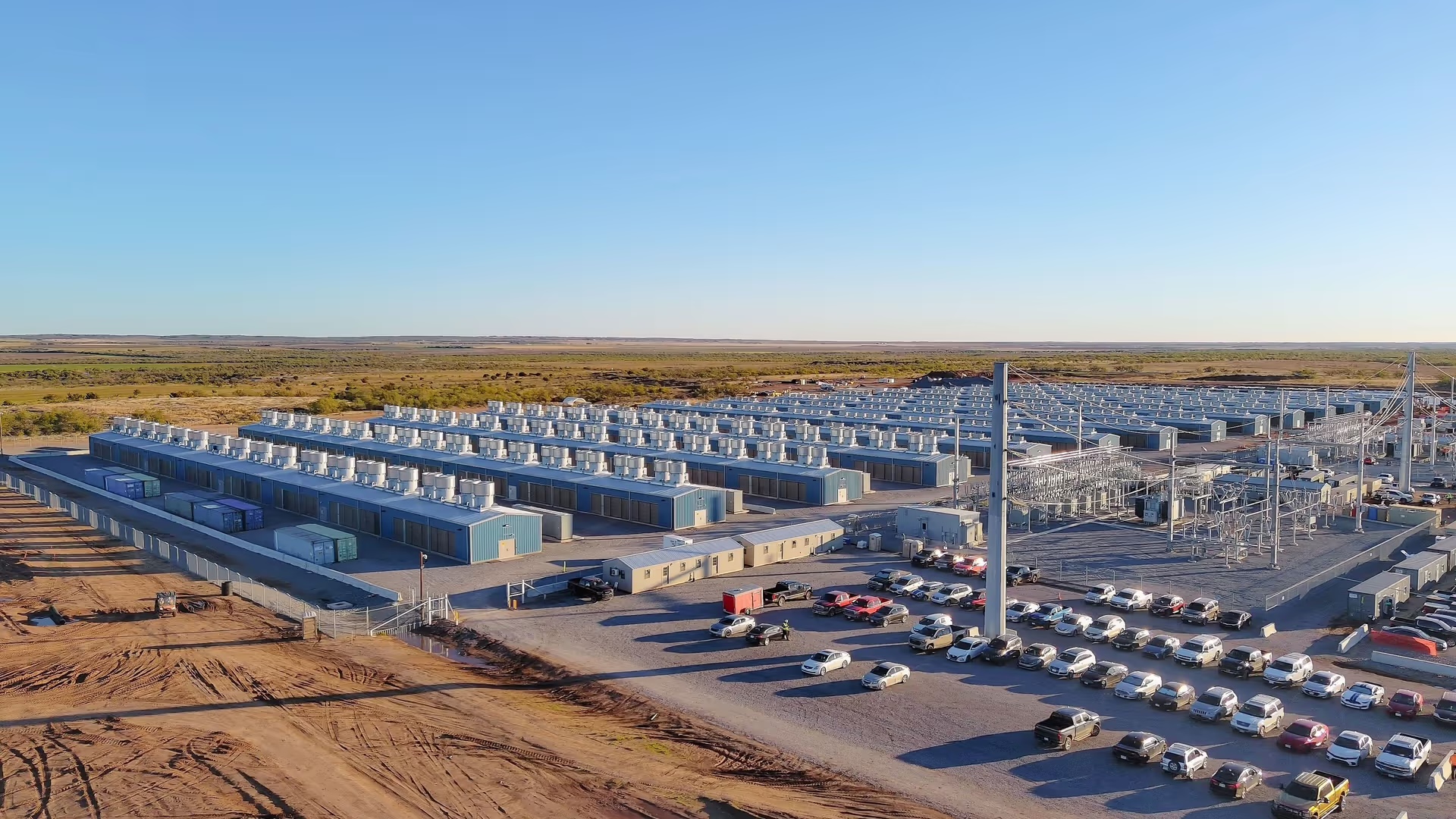
The tension is not whether Childress exists. The company’s published aerial shows long blue-gray halls, rows of white rooftop cooling units, a substation on the right, and a full parking lot on the West Texas plain. No wordmark is readable in the frame. The tension is who funds the next buildings if the equity window stays shut.
Roberts splits the funding. GPU capex on signed contracts is mostly prepay plus secured debt, near 6% for Microsoft and 9% fixed at Mackenzie. The buildings, he says, were paid for in cash, with no debt on those assets, and new paper will cost what the market charges. Sommer’s point is that industry revenue may not earn a full return on all of that capital. Sold-out 2026 capacity can still leave the equity absorbing a wider spread, a late acceptance, or another share sale.
FinanceFeeds reported in May 2026 that a $3 billion convertible notes offering had closed. By 30 June, convertible principal was $6,745.7 million. Friday’s $9.81 billion of equity sits in front of that claim, $13.81 billion of commitments, and an at-the-market program that has raised $2.49 billion. The exhibit’s $14 billion capitalization line, cash plus committed GPU financing and prepayments, is dated 27 August. Nothing opened here renews it after October.
What happens next
On 5 November 2026, Nasdaq lists earnings and the company news index carries the Q1 FY27 release. The quarter ended 30 September. If the share count is still 394,058,648, October was a multiple on a fixed count and $30.63 is a price on that count. If the sales agreement printed shares after 14 August, $9.81 billion overstates what the August holder still owns. A soft AI-cloud number can mean Horizons 2 through 4 were not yet accepted, which is when revenue generally begins. That delays recognition. It does not delete the $9.7 billion.
Through calendar Q4 2026, with grace into the beginning of Q2 2027, those horizons are the delivery test. The $4 billion ARR target for 31 December depends on commissioning, testing, and acceptance, and recognized revenue may be materially lower. Acceptance keeps the book and the tape on the same object. A slip into the grace window keeps the contract and hands traders a reason to price the bear. The $10.22 bear is the formula, not an appraisal of the halls.
On 31 December 2026 the 47-session path ends. The bull does not require Badajoz, a Canal Flats permit, or an unnamed customer. It requires the recent distribution, negative drift included, not to steepen. That is why $30.63 is only about 23% above Friday and still under the 20-day average. The base of $15.85 is the drifted mean. Another equity sale, or a delivery miss treated as a broken book, is how the path can reach $10.22 with Microsoft still in the 10-K.
Bull, base, and bear
N is 47, from Monday 26 October through 31 December 2026, skipping Thanksgiving Day on 26 November and Christmas Day on 25 December. The early closes on 27 November and 24 December count. The sample is the last 90 daily log-returns. Mu is -0.009617 and sigma, the sample standard deviation with n minus 1, is 0.064061.
The base is $24.905 times e to the power of N times mu, which is $15.85. The bull is $24.905 times e to the power of N times mu plus 1.5 times sigma times the square root of N, which is $30.63. The bear is $24.905 times e to the power of N times mu minus sigma times the square root of N, which is $10.22. Figures are rounded half up to the cent. The bull stays above the spot, so the negative drift stays in the bull.
| Case | Price | Versus $24.905 | What has to be true |
|---|---|---|---|
| Bull | $30.63 | Up 23.0%, or $5.72 | Forty-seven sessions follow the recent distribution, drift included, to 1.5 standard deviations above the mean. No new contract is required. |
| Base | $15.85 | Down 36.4% | The mean of the last 90 log-returns persists. The contracts can stay in the 10-K, because the base is the drift, not a cancellation. |
| Bear | $10.22 | Down 59.0% | The same mean, minus one standard deviation scaled by the square root of 47. A share sale or a delivery miss can travel this way. It is not a liquidation value. |
The pair is not the older FinanceFeeds bulls of $100, $92, $84, or $65, and it is not the separate $105 figure.
FAQ
Where do the sessions through 31 December 2026 put a fresh bull and bear from the latest official IREN close, and is the stock still being priced as if the AI-cloud contract book and the share count moved together?
The bull is $30.63, the base is $15.85, and the bear is $10.22 from the $24.905 Friday close, and the October drop is a multiple move if the share count did not expand with it. The count on file is 394,058,648 ordinary shares as of 14 August 2026. On that count the shares were about $17.39 billion on 25 September and about $9.81 billion on 23 October. The Microsoft and NVIDIA figures did not shrink with the tape.
Why is the base under the Friday close?
The base is under the close because the mean of the last 90 daily log-returns is negative, at about -0.009617 per session. Compounded over 47 sessions, that drift takes $24.905 to $15.85. The bull keeps the same drift and adds 1.5 standard deviations, which is why $30.63 is only $5.72 above the close. Removing the drift would print a higher bull. This article does not use that higher number.
Did the Microsoft contract leave the book in October?
The Form 10-K filed on 27 August 2026 still describes about $9.7 billion of Microsoft contract value, Horizon 1 accepted in August, and Horizons 2 through 4 targeted for calendar Q4 2026 with grace into the beginning of Q2 2027. Nothing opened for this article shows a cancellation. Revenue generally starts only after acceptance, so a gap in recognized revenue is built into the contract as written. That is timing, not a finding that Microsoft exited.
What share count is inside the $9.81 billion figure?
The figure is 394,058,648 ordinary shares, the count on the 10-K cover as of 14 August 2026, times the $24.905 close. The 30 June 2026 balance sheet showed 380,193,608 shares, and 30 June 2025 showed 258,103,209. No later filing in this reporting updates 14 August. If the at-the-market program sold shares after that date, the $9.81 billion comparison is stale on the settlement day, which is why 5 November matters.
What is the next dated test, and what would actually change the call?
The next date is 5 November 2026, when Nasdaq lists earnings and the company has scheduled Q1 FY27 results. A higher share count would mean the October decline was not only a multiple on a fixed count. An acceptance update on Horizons 2 through 4 would show whether the $4 billion ARR target is still a 31 December story or a grace-period story. The year-end prices change only if a new official close replaces $24.905 as the spot.
Is $30.63 a street price target?
No. It is the upper band of this distribution: the Friday close, the last 90 log-returns, and 47 sessions through 31 December 2026. It sits below the 20-day average of $34.39. Analyst targets compiled by data vendors are a separate set of opinions and are not an input here. The bear of $10.22 is the lower band of the same arithmetic, not a forecast that the Childress site would fetch that per share in a sale.